Special Relatives - Fourth Update
The Forgotten Mentor

“It was from my father [Professor Dr. Jost Winteler] that I first heard discussions on relativity, which Einstein...later developed mathematically,” wrote Dr. Fritz Winteler to the Directorate of the Swiss National Library in Bern on April 10, 1942. An astounding statement? Of course. Perhaps a provocative one for many in the world of science. But there comes a time in history when a revisionist endeavor presents opportunities for reconsideration.
Likely unknown to Fritz were two linguistic scholars who were already intrigued by his father’s work: Roman Jakobson and Nikolaj Trubetzkoy, who in 1931 found—by pure chance—his father’s long forgotten scientific dissertation in philology as a student in 1876. They were awestruck by the genius of Winteler’s groundbreaking distinction between relational invariants and variations within language - deriving meaning from relationships between systems rather than in isolation. Winteler’s pioneering principle was Relativität der Verhältnisse - or configurational relativity: “Speech sounds cannot be evaluated in isolation but only in their relation to all other sound units of the given language and to the linguistic functions assigned to them in such a manifold,” wrote Jakobson in the September 1972 Scientific American.
Back in the 1950s, when Jakobson accidentally learned of the deep connection between Winteler and Einstein, he rushed to contrast their scientific methods and identified Winteler’s emphasis on the “relativity of relationships” in his breakthrough work. “The question of what influence was exerted on him [Einstein] by his daily conversations with the lucid scholar suggests itself,” wrote Jakobson. There’s an uncanny resonance to Einstein’s initial desire to call his relativity the Theory of Invariance.
So, was Jost’s early work on configurational relativity part of the conversations with Albert? Dr. Fritz Winteler wasn’t just Jost’s son - he was a chemist who would have grasped the scientific significance of what his father taught. His 1942 statement to the Swiss National Library carries the weight of one scientist testifying about another: “It was from my father that I first heard discussions on relativity, which Einstein later developed mathematically.” If Jost discussed configurational relativity with his scientist son, there’s every reason to believe he explored these ideas with Albert Einstein during their countless hours of discourse.
Their commitment to ideas transcended personal wounds. Though Einstein had broken his engagement to Jost’s daughter Marie, both men chose to preserve their intellectual bond over family grievance. In 1901, Einstein wrote about serving as Jost’s tour guide during Easter vacation in Milan: “Professor Winteler, to whom of course I must devote myself a great deal, is now here,” adding, “He ignores the ‘casus belli’ - the justification for war - saying, girl matters, private matters, and prefers to talk with me about other things.” Jost refused to let his daughter’s heartbreak become grounds for ending their relationship. Letters from many highly successful former students, colleagues, peers, and his family are a testament to the man who embodied the spirit of discussion, debates, and imparting knowledge to lift his followers to a higher level - to explore for, as Jost put it, “divine ideas for the human race.”
Back when it all began in that stressful, but critical year of 1895, given the urgency the Einsteins faced to place their son, the results of both his school and living arrangement could not have been better. Left behind was the miserable abandonment in Munich and the vapid, lonely apartment in Milan. Whatever was missing at that point in Albert’s life was more than compensated for when he stepped inside the Winteler home. He walked into a family dynamic of stimulating mental nourishment from a professor who became his Papa and found himself enveloped in family love.
Now in Aarau, in the complete rebirth of the spirit of his youth, Albert embraced the attention “where it is too charming and one always gets pestered in such a lovely way,” he said in 1899, as he was drawn into the lives of a boisterous and spiritual household.
What would it all mean for his life, the Wintelers, and the world of science? Just as his ‘Papa’ Jost Winteler accurately predicted Germany’s downfall long before it happened, his ‘Mama’ Pauline Winteler’s constant prediction that “Albert will be a famous man one day” would also come true. The seeds of genius found fertile ground in the Winteler home - where love, mentorship, and revolutionary ideas about the relativity of relationships may have shaped the mind that would transform our understanding of space and time itself.
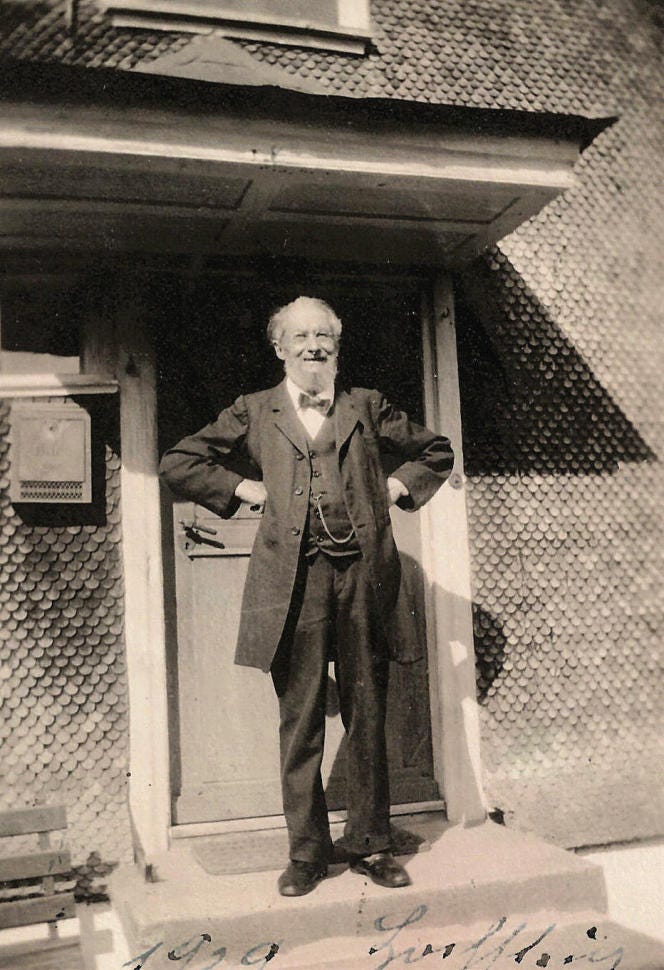
Photo: Professor Dr. Jost Winteler (late 1920s). “He who gives much will give something to everyone.”