Special Relatives - Sixth Update
Ghosts of First Love

The love story between Albert Einstein and Marie Winteler has been mentioned in many Einstein biographies, but they are shallow and incomplete. I wish to change that.
Their story resurfaces as I write the final chapter of the book. But Marie has made my eyes well up again. Unguarded in several letters and poems to Albert while humanity was on the cusp of a Second World War, she hid nothing, describing exactly how she felt. While the full arc of her difficult life still has gaps, their trail of broken hearts reveals itself.
Their love story began when Albert—self-confident but adrift—moved into the Winteler home in Aarau in October 1895. Just teenagers, Albert and Marie’s eyes met for the first time. Nobody could have anticipated what would happen next. Emotionally detached, the young man felt unfamiliar emotions. Vivacious and radiant, Marie became the undoing of all his defenses. Their piano-violin duets of Mozart became a theme of romance and love, and as they put it, intertwined their souls. Whenever one was away, they wrote constantly. What poured out from Albert’s heart even surprised him. Never again would he write such romantically inspired prose. “It’s true, isn’t it, little Marie? You wouldn’t have thought that I could write in such a stupid and muddled way.” He wrote about her soul: “Isn’t it arrogant,” he wrote her, “to think that it could find enough room inside my heart?”
It was there, in the halcyon days of his love—stepping out into the blackness of Aarau’s starlit nights—he taught Marie about the heavens. “Oh, Orion is sparkling beautifully tonight as never before,” he wrote her.
It was there, in the halcyon days of her love—spiritually awakened—Albert had his first thought experiment about riding a light wave.
It was there, in the halcyon days of his life, his universe had a heartbeat.
“I love you for all eternity,” Marie told him.
Then it seemed that an undefinable force later began to tug on Albert. Conflicted, he abandoned Marie, seeking a path of science. She was left standing alone, confused, devastated. Without knowing it, behind them remained a sense of timelessness about their love that defined the purity and eternity of the universe. Tormented, it would haunt them for the rest of their lives.
A decade later, he spiraled back to her—a loveless, broken man—asking for her hand. She sensed the same conflict within, tearing him apart. What she wanted and what she chose changed the course of history. General Relativity followed.
The Second World War then loomed. Though the ghosts of first love were forced an ocean apart, a flow of letters carried them back to each other. Albert wanted her thoughts—in poems. Remembering their duets, he offered to buy her a piano. She sent him her poetry, one about a love she tried to bury, but could not. For with every tear, she said, sprouted a flower. Unguarded once again, she posed a final, haunting question: whether the future they were denied was never meant to be found in this life — but in the next.
Their love never died. It was only waiting.
In the blackness of night, as I look up to Orion shining so brilliantly, deep in my soul I somehow feel they are no longer waiting.
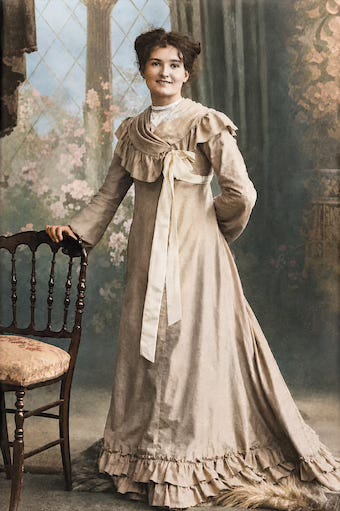
Photo: Marie Winteler at age 18.